What are Indicators? Using Decision-Making Tools Wisely
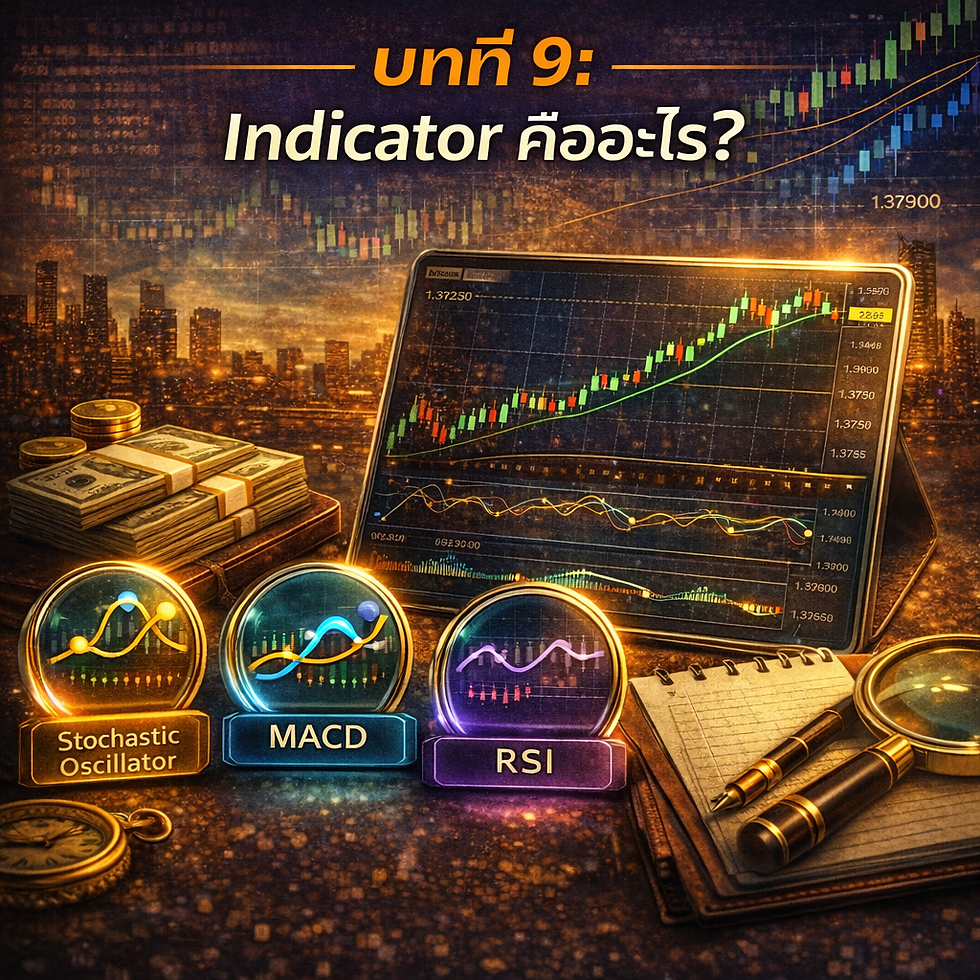
Once you have learned to read candlesticks and identify trends with your naked eye, trading platforms like MT4/MT5 offer additional "assistants" called Indicators. These tools help you visualize market data that might be overlooked at first glance.
1. What is an Indicator?
An indicator is a mathematical calculation based on historical price data (Open, Close, High, Low, and Volume). The results are displayed as lines or symbols on your chart to help you forecast potential price movements more easily.
2. Popular Indicators for Beginners
We can categorize the most common indicators into two main groups:
Trend Indicators: Such as the Moving Average (MA). These help identify the current market direction by smoothing out price noise. For example, if the price is consistently above a moving average line, it often signals an uptrend.
Oscillators: Such as the RSI (Relative Strength Index). These help measure market momentum and identify Overbought conditions (market has risen too much) or Oversold conditions (market has fallen too much), suggesting a potential pullback or reversal.
3. The Indicator Trap
A common mistake for beginners is adding too many indicators to a single chart—a phenomenon often called "Indicator Soup."
Indicators are "Lagging": Most indicators follow the price; they don't lead it. They calculate based on what has already happened.
Overcomplication: Using five different indicators that all tell you the same thing doesn't make your analysis more accurate. It only creates confusion when they eventually contradict each other.
The Discipline of Tool Usage: The Discipline Message
A disciplined trader uses indicators only as "Confirmation Tools," not as the primary driver of their decisions.
The Rule of 1-2: Choose only 1 or 2 indicators that you truly understand to support your analysis.
Price is King: If an indicator signals a 'Buy' but the candlesticks are crashing downward, a disciplined trader trusts the Price Action unfolding right in front of them over a statistical formula.
Wait for the Signal: Define exactly what an indicator signal looks like in your plan. If the signal isn't 100% complete, "Do Not Trade"—no exceptions.
"The best indicator is the discipline to wait for the clearest signal."
Next Lesson: Now that you have your weapons and know how to read the map, we are entering the "Heart of Survival." This next topic is more important than every trading strategy combined: Money Management (MM)—the art of protecting your capital and preventing a blown account.
Series Table of Contents: Forex Fundamentals & The Path to Success
Ch 1: What is Forex? Trading Basics Simplified
Ch 2: Why Trade Forex? A Path to Freedom or a Debt Trap?
Ch 3: Bid, Ask, and Spread: The Costs You Must Know
Ch 4: Pips and Points: The Trader’s Ruler
Ch 5: Lots and Leverage: Mastering the Power of Multipliers
Ch 6: MetaTrader 4 & 5: Mastering the World’s Standard Trading Tools
Ch 7: Candlestick Charts: Reading Market Psychology through Price
Ch 8: What is a Trend? Trading with the Trend for Sustainable Profits
Ch 9: What are Indicators? Using Decision-Making Tools Wisely
Ch 10: Money Management (MM): The Iron Rule to Protect Your Capital
Ch 11: Trading Systems: Building Your Personal Profit Machine
Ch 12: Trading Mindset: The War Within Yourself
Ch 13: Choosing a Broker: Finding a Safe "Vault" for Your Funds
Ch 14: Economic News: How to Survive Market Storms
Ch 15: Professional Roadmap: Conclusion and the Sustainable Journey Ahead


Comments