Trading Without Risk Management is Nothing More Than Gambling
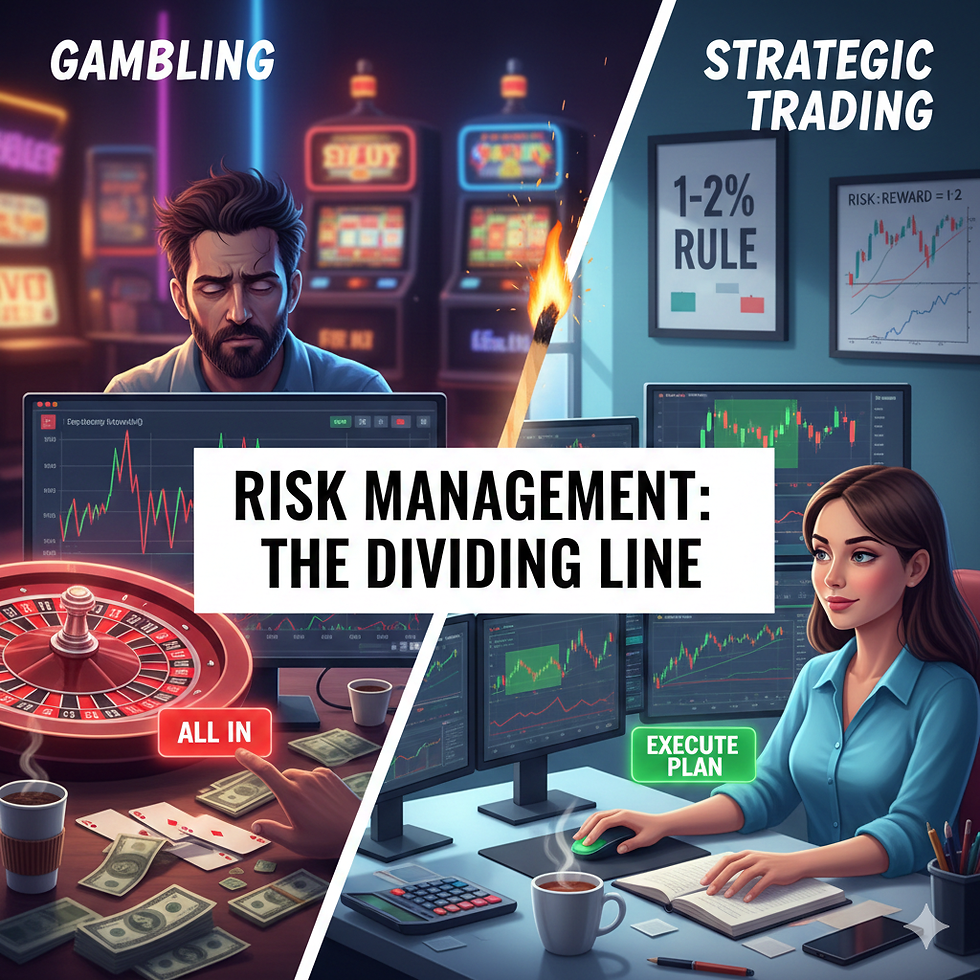
In the world of finance and investment, Forex (Foreign Exchange) often carries an image of rapid wealth, volatile charts, and the chance to turn a few dollars into a fortune. However, behind this allure lies a trap that has caused many new traders—and even some veterans—to blow their accounts entirely.
The number one reason for failure isn't a lack of "chart analysis" skills; it's the inability to distinguish between "Systematic Trading" and "Speculative Gambling."
If you are entering trades without calculating your potential loss or hoping that a "single big win" will make you rich, this article will show you why trading without Risk Management is no different from walking into a casino.
1. Defining Gambling vs. Quality Trading
To understand the context, we must first look at the fundamental differences between these two behaviors:
Gambling: Placing money on high-uncertainty events while relying on "luck" or fate. Players usually have no control over the edge and are mathematically destined to lose to the "house" in the long run.
Professional Trading: Using statistics and mathematical principles to create an "Edge." A pro trader knows that in 100 trades, they might lose 40 times. However, the 60 winning trades will generate profits that far exceed the total losses.
The Golden Rule: "Trading isn't about being right or wrong; it's about how much you make when you're right and how little you lose when you're wrong."
2. How Lack of Risk Management Turns You Into a Gambler
Without a risk management plan, your brain switches from "Investor" mode to "Gambler" mode through these destructive behaviors:
A. Over-Leveraging (Overlot)
This is the deadliest weapon in Forex. Opening positions far too large for your capital (e.g., using a $100 account to open a 1.00 Lot) in hopes of a quick windfall. A small price spike against you can wipe out your account instantly. This is the equivalent of putting all your money on "Red" in Roulette.
B. Trading Without a Stop Loss
Gamblers rely on "Hope" as their final strategy. When a trade goes south, they refuse to cut losses due to the pain of losing money, hoping the market will eventually reverse. Letting a "Floating Loss" run indefinitely is essentially betting your entire portfolio's life.
C. Revenge Trading
After a loss, a gambler feels anger and an immediate need to "get it back." They might double their lot size (Martingale) to recover losses in a single trade. Statistically, this is the beginning of the end.
3. The 3 Pillars of Risk Management
To transition from a gambler to a professional trader, you must install these three systems:
Risk Per Trade: The most popular rule is the "1-2% Rule." This means you never risk more than 1-2% of your total capital on a single trade. For example, with a $1,000 capital, a 1% risk means you only lose $10 if the trade hits your stop loss.
Risk to Reward Ratio (R:R): This is the "Edge" that makes you a long-term winner. If you set an R:R of 1:2 (Risk $10 to make $20), you can lose 50% of your trades and still come out profitable.
Position Sizing: Professional traders don't use the same lot size every time. They calculate the lot size based on the distance to their Stop Loss to ensure the dollar amount risked remains constant.
4. The Psychology: Why Do We Love to "Gamble" in Forex?
The human brain is wired for Dopamine, which is released during unexpected rewards. Winning big on a "lucky" trade provides a higher rush than slow, consistent gains. Additionally, the Gambler's Fallacy—believing that because the price has dropped significantly, it must go back up—leads many to trade against the trend based on emotion rather than technical reality.
5. Self-Check: Are You Trading or Gambling?
If you answer "Yes" to most of these, you are likely gambling:
Do you feel a racing heartbeat or intense anxiety when opening a trade?
Do you often skip setting a Stop Loss?
Do you pray for the market to return when you see a deep red floating loss?
Do you have no clear plan for where to take profits?
Do you "Overtrade" even when there are no clear signals?
6. Conclusion: Risk Management is Your "Bulletproof Vest"
In the Forex market, no one knows with 100% certainty where the price will go. The only difference between winners and losers is that winners have a robust risk management system. They accept small losses to survive for the big wins.
Don't let greed turn a powerful wealth-building tool like Forex into a casino. In the long run, the house (the market) always wins if you don't manage your risk.
Step Up to Professional Trading
Now that you understand that trading without risk management is gambling, the next step is building the "Discipline" and "System" for sustainable profit. Check out these guides:
Follow us for more insights on turning discipline into freedom: Discipline 2 Freedom Blog


Comments