5 Best Forex Indicators for Beginners: A Simple Guide to Profitable Trading

Entering the Forex market without indicators is like sailing the ocean without a compass. While indicators aren’t "crystal balls" that predict the future with 100% certainty, they are statistical tools that help you identify the probability of market movements.
Following our deep dive into the 5-Minute Scalping Strategy, today we will explore the 5 essential tools that will transform your chart analysis from guesswork into a systematic process.
Why Should Beginners Use Indicators?
Indicators help remove "emotional bias" from your decision-making. They translate chaotic price data into easy-to-understand lines or bars, helping you answer three critical questions:
What is the current trend? (Trend)
Who is in control—buyers or sellers? (Momentum)
How volatile is the market right now? (Volatility)
1. Moving Average (MA) – The King of Trends
Moving Averages smooth out price action by averaging closing prices over a specific period.
Recommended Settings: EMA 50 (Intermediate) and EMA 200 (Long-term).
How to Trade:
Golden Cross: When a short-term EMA crosses above a long-term EMA (Buy signal).
Death Cross: When a short-term EMA crosses below a long-term EMA (Sell signal).
Pro Tip: If the price is above the EMA 200, only look for Buy setups.
2. Relative Strength Index (RSI) – Measuring Momentum
RSI measures the speed and change of price movements, oscillating between 0 and 100.
The Key Levels:
Overbought (> 70): The price may have risen too far; expect a potential pullback or reversal (Prepare to Sell).
Oversold (< 30): The price may have fallen too far; expect a potential bounce (Prepare to Buy).
3. MACD – The Momentum Powerhouse
The MACD (Moving Average Convergence Divergence) consists of the MACD line, the Signal line, and the Histogram.
Clear Entry Signals:
Buy Signal: When the MACD Line crosses ABOVE the Signal Line.
Sell Signal: When the MACD Line crosses BELOW the Signal Line.
Best Practice: Signals are strongest when the crossover happens near or across the "Zero Line."
4. Bollinger Bands (BB) – The Volatility Ruler
Bollinger Bands consist of three lines that expand and contract based on market volatility.
How to Profit:
The Squeeze: When the bands tighten significantly, it indicates that the market is "coiling up" and a massive breakout is imminent.
The Bounce: In a sideways market, the price tends to bounce off the lower band (Buy) and the upper band (Sell).
5. Stochastic Oscillator – Precise Short-Term Reversals
The Stochastic is a sensitive indicator that identifies turning points. It consists of the %K line (Fast) and the %D line (Signal).
Trade Setup:
Buy Signal: When the %K line crosses ABOVE the %D line while in the Oversold zone (below 20).
Sell Signal: When the %K line crosses BELOW the %D line while in the Overbought zone (above 80).
The Winning Formula: Combining Indicators
Never rely on a single indicator. To increase your accuracy, use a combination:
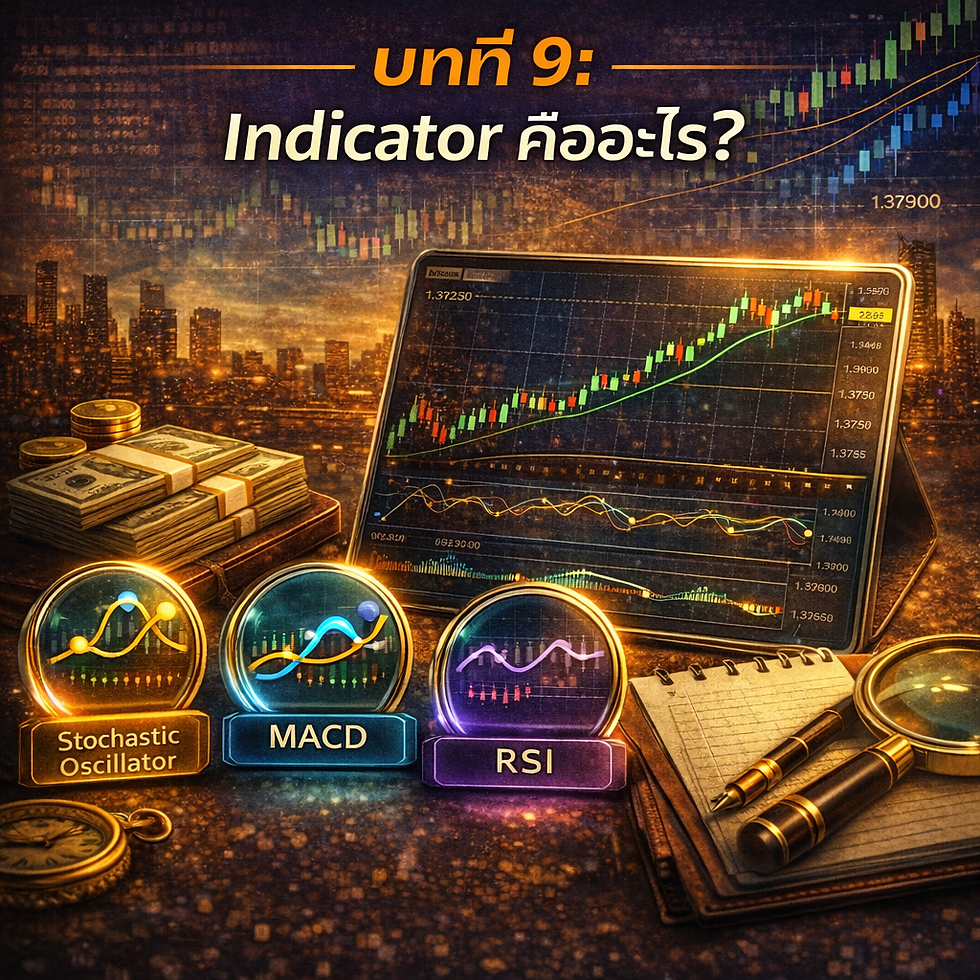
EMA 200 (Identify Trend) + MACD (Identify Momentum) + Stochastic (Identify Entry Point)
Example: If the price is above the EMA 200 (Uptrend), wait for the MACD to cross upward and the Stochastic to cross upward in the Oversold zone. This alignment offers the highest probability of success.
Conclusion
Indicators are tools, not guarantees. The key to long-term success is mastering 1 or 2 indicators and combining them with solid Risk Management. Start practicing on a Demo account to see which tool fits your trading style best!


Comments